

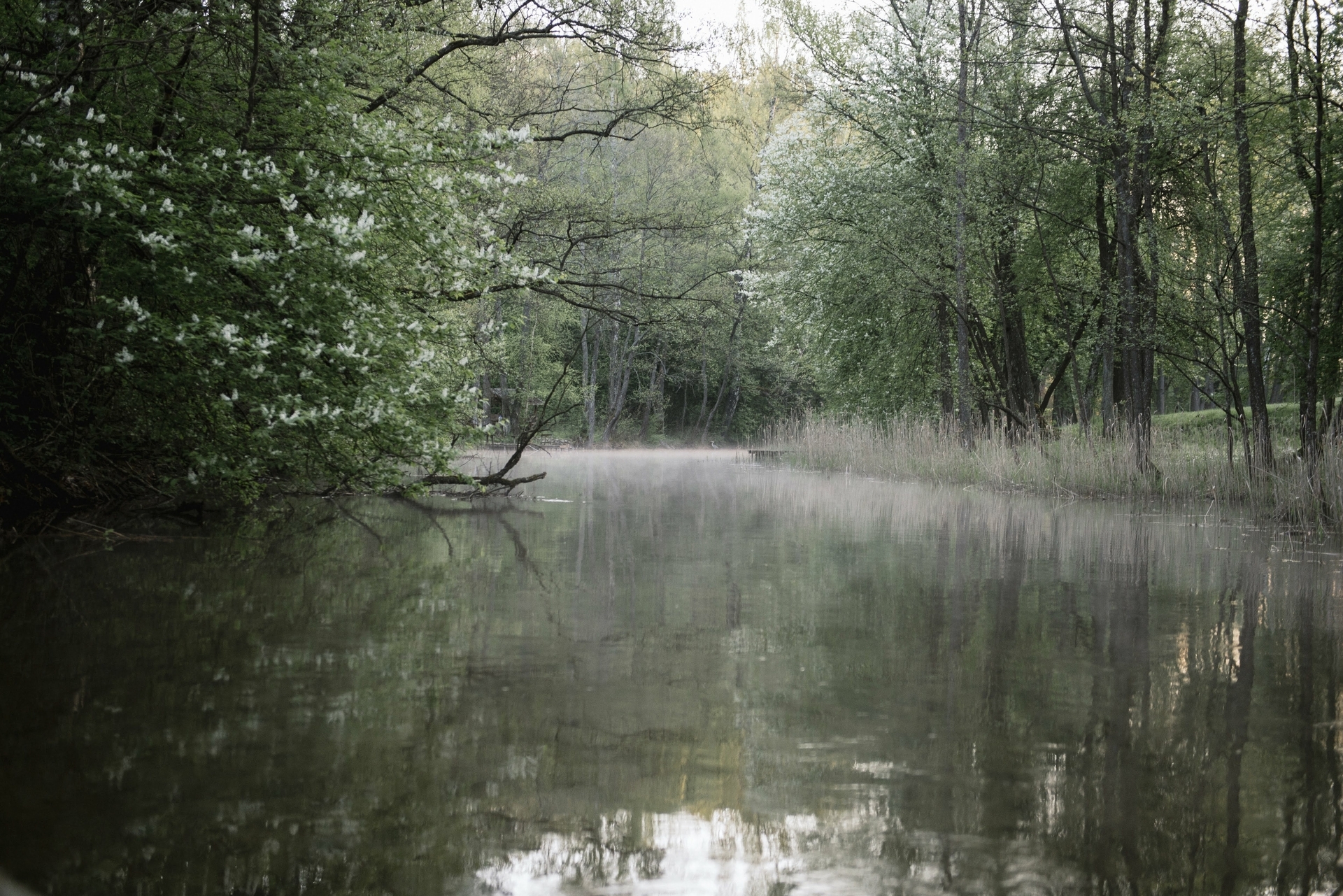
Starting your kayaking trip on Lake Utenykštis, paddle a few hundred meters while keeping to the right shoreline, passing around the Utenykštis headland. Continue along the right bank, paddling through the Lašmuo Strait, notable for its rich marshland flora. After passing through the reeds, you will cross the strait and continue your journey along the Būka River.
During the trip, you will be able to rest in ethnographic areas and campsites set up along the river. The banks of the Būka River border dense forests that enrich its waters. On the left side of your paddling direction stretches the Ažvinčiai Forest, while on the right lies the Vyžiai Forest. Thus, while paddling this river, you will not only discover its rich flora and fauna, but also see for yourself that the Būka is one of the cleanest rivers in Lithuania.
In the past, the Būka River was used for timber rafting. As you know, water levels in rivers vary in certain sections, so water levels were artificially raised to ensure optimal log transportation. Remnants of old wooden dams can still be seen during your journey.
After paddling about one kilometer from the starting point (the source of the Būka River flowing out of Lake Utenykštis), you will reach the Ineiga rest area. This is a good place to take a break after the start — but don’t linger too long, as the journey has only just begun!
You may encounter clusters of water lilies along the way. Water lilies are listed in the Red Book, so please act responsibly — do not pick or damage them. If you like collecting plants as souvenirs, look for water mint hidden among the reeds along the riverbanks. Its flowers are not only beautiful — at the end of the trip, you can brew a delicious mint tea for yourself and your fellow travelers.
Soon you will notice Vaišnoriškės village, recognizable by its 19th–20th century buildings, with wooden piers extending from the homesteads into the river. Passing the piers, you will paddle under a small bridge that connects the roads of Tauragnai and Braslavas. Near this bridge, on the left side of your paddling direction, notice an ethnographic site: a tavern once stood here, mentioned as early as 1765. The first homestead was established here in 1830, followed later by four more.
After passing Vaišnoriškės and the road bridge, the Būka River narrows and becomes more winding. This stretch is characterized by occasional deep spots and a stronger current. And of course, fallen trees across the river are unavoidable — you will encounter more than one. Some kayaks may need to be carried over logs or along the riverbank. Remember that wet wood is slippery, the riverbed is not always even, and the current can disturb your balance. Work together — unless you’re eager to take an unplanned swim in the fast-flowing waters of the Būka.
Note that the river sometimes forms bays that may resemble branches of the river. You can identify the true river channel by observing the current — free-flowing water and moving vegetation.
And now — you have completed your journey along the Būka River. Its finale is the Lake Baluošas, rich with seven islands, which you are just entering. The silence of Lake Baluošas is preserved by surrounding pine forests, whose resinous scent you can probably already smell. Upon entering the lake, keep to the right side and you will find the Adomragis rest area. Take a break and refresh yourself here, as a wide variety of Aukštaitija waters awaits you on the way to Almajas campsite.
At the Adomragis rest area — especially on the tip of the peninsula — you’ll find a clear and convenient shoreline inviting you to swim. This is a perfect place for a dip, but not for leaving trash: please respect nature and leave no litter. There are no trash bins here — you can dispose of waste at the Almajas campsite. Until then, keep your trash in a bag inside your kayak.
After resting and having a snack, it’s time to decide which direction to paddle next. This depends on your strength and remaining supplies.
THERE ARE 2 WAYS TO CROSS LAKE BALUOŠAS:
Option 1 (~1.5 km, ~20 minutes): From the Adomragis rest area, paddle straight to the stream connecting Lake Baluošas and Lake Baluošykštis. The distance is about 1.5 km or 15–20 minutes. Paddle toward the opposite shore of the lake. Liepų Island should remain on your left, and the Beržaragis Peninsula on your right. From Beržaragis, you will see a bridge under which the connecting stream flows.
Option 2 (~4.5 km, up to ~1.5 hours): Explore the natural wonders of Lake Baluošas and visit Ilgasalė Island — a unique hydrological feature, as Ilgasalė is the only lake island in Lithuania that contains its own lake.
IF YOU CHOOSE OPTION 2:
To visit the most beautiful parts of Lake Baluošas, paddle from the Adomragis rest area along the left shoreline. Soon you will see the ethnographic Šuminai village, first mentioned in historical sources in 1784 under the name Pabaluošė. A pine tree about 300 years old grows here. However, Šuminai is best known for being a filming location of the famous Lithuanian film Tadas Blinda in 1972. The so-called Tadas Blinda’s villa can be pointed out by any local resident.
Leaving Šuminai behind, paddle past Degėsis Island toward the last and longest island of Lake Baluošas — Ilgasalė. Upon reaching the southeastern end of Ilgasalė, paddle into a bay and look for a narrow stream hidden among vegetation, through which you can enter the inner lake by kayak.
After exiting the Ilgasalė lake, return the same way you came from Šuminai, then turn left and paddle southeast, keeping close to the shoreline. In the distance, you will see a peninsula. After rounding it, if you still have time and energy, you may enter a bay to visit a local landmark — the Trainiškis Oak, approximately 800 years old, which was toppled by a strong storm in 2016. Since then, visitors can view not only the massive trunk but also the tree’s crown.
Leaving the Trainiškis bay, you will see another small peninsula on the left. From there, paddle straight toward a larger peninsula visible in the distance. After rounding it and continuing along the left shoreline, you will enter a large bay of Lake Baluošas. At its end, you will find a ~150 m long stream connecting Lake Baluošas with Lake Baluošykštis. This fast-flowing stream will carry you into another adventure-filled lake system.
Paddle along Lake Baluošykštis toward its source, keeping Simoniškis village on your left and Vaidžiuškės village on your right. After crossing the lake, slightly to the left among the reeds, you will notice the source of the Skriogžlė Stream.
The Skriogžlė Stream is about 0.9 km long. It may appear narrow and deep, with several sharp bends. Its banks are wooded and steep. Storms have knocked several trees into the stream, but you can pass them by lifting or jumping the kayak over the obstacles — provided you gain enough speed. After a few more bends, you will enter Lake Sravinaitis.
In Lake Sravinaitis, keep to the right shoreline until you reach an island shaped like a peninsula. Pass it on the left (keeping the island on your right), and you will reach the famous Ginučiai Water Mill.
The Ginučiai Mill operated until 1968. A decade later, it was restored and is now a state-protected 19th-century technical monument. Inside is a museum where you can see authentic historic mill equipment. The museum is open from May to October (Tuesday–Saturday 10:00–18:00, Sunday 10:00–15:00).
Disembark on the right side of the mill dam and carry your kayaks across it. Don’t miss the chance to swim in the powerful flow of water cascading from the dam chute!
After enjoying the current, get back into your kayaks and enter the Srovė River. Soon you will reach its confluence with the Almaja River, which flows out of Lake Almajas. Turn right into the Almaja River and paddle upstream directly into the lake. You may feel resistance near the river’s source, but once you enter the lake, you can rest. In Lake Almajas, paddle along the right shoreline, pass a pointed peninsula, and soon you will see the Almajas rest area.
Information prepared by www.trainiskis.lt
Information updated on 2026-02-24
Reviews