

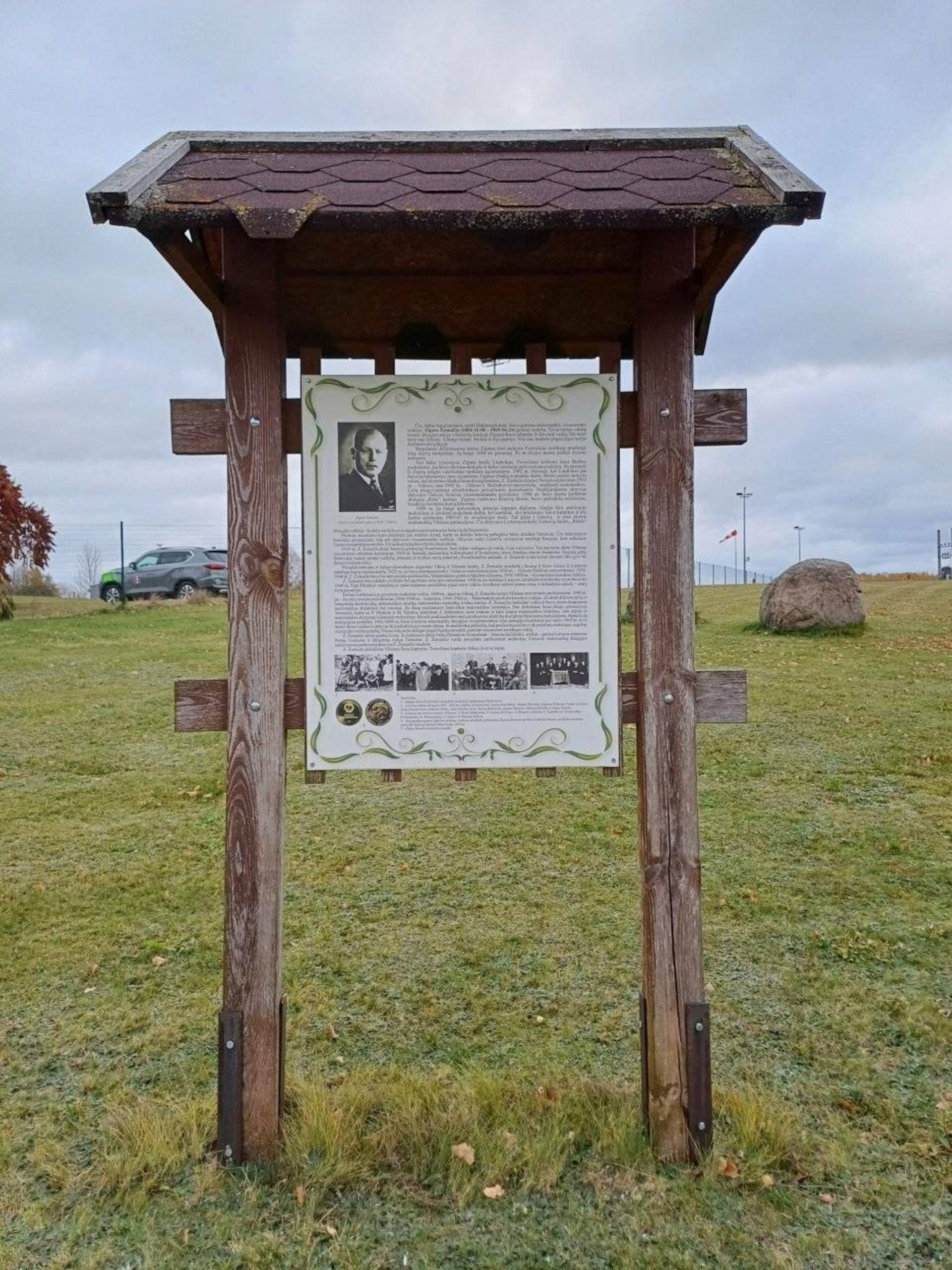
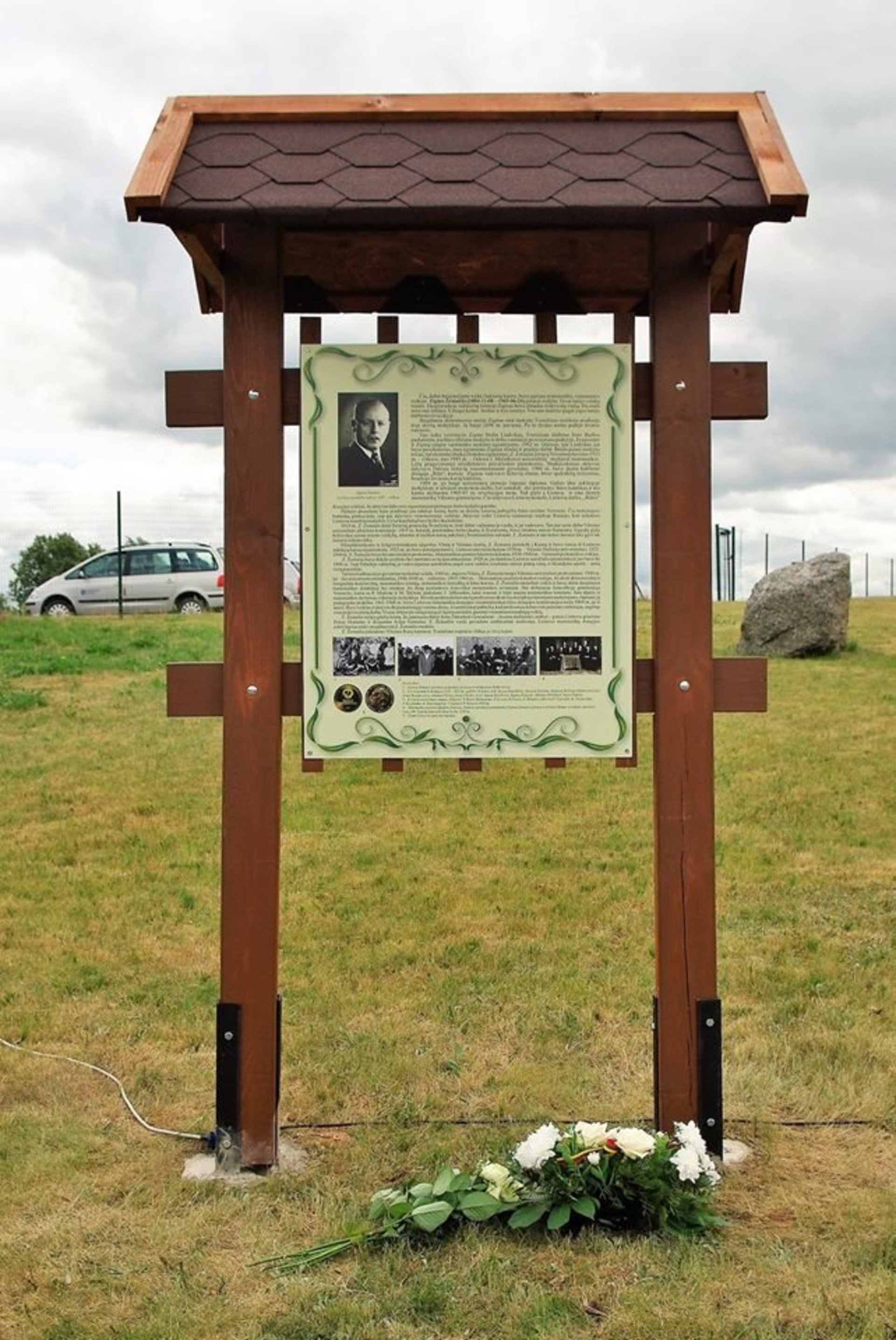
One of the pioneers of Lithuanian sports aviation, Zigmas Žemaitis, was a Lithuanian physicist, mathematician, aviator, public figure, and one of the first professors of the Lithuanian University. The village of Daktoriai, where he was born, has disappeared, therefore an informational stand was unveiled next to the Tverečius border guard post, located at the former site of the village.
Zigmas Žemaitis was born in 1884 in the village of Daktoriai near Tverečius. He was the eighth of nine children. His parents owned one valakas (a historical land unit), so there was enough work for everyone, but no surplus. He completed three classes at the Tverečius public school, where instruction was conducted in Russian. At that time, an enlightened priest and protector of book smugglers, Jonas Burba, served in Tverečius and encouraged parents to send their more talented children to study. Thus, the Žemaitis family sent their eldest son Liudvikas to train as a pharmacy assistant. Liudvikas later helped Zigmas pursue higher education. Both brothers went to Odessa, where Zigmas passed the pharmacy apprentice exams, worked in a pharmacy, and, encouraged by his brother, continued his studies externally.
In 1903, he entered the Faculty of Physics and Mathematics at Novorossiysk University, later transferring to Odessa University, which he graduated from with a first-degree diploma. He was offered a position at the university, but his participation in the 1905–1907 revolutionary events prevented this. He was an active public figure. While still a student, during a vacation at home, he encouraged the people of Tverečius to hold demonstrations and narrowly avoided arrest. He actively participated in the Lithuanian cultural society „Rūta“ and other organizations. In 1909, he returned to Lithuania and became an active member of the Lithuanian Scientific Society. Only with difficulty did he obtain a teaching position in Vilnius gymnasiums, as the Russian authorities considered him politically unreliable.
During World War I (1915–1918), he taught at Lithuanian gymnasiums in Voronezh. He was a member of the Supreme Lithuanian Council in Russia. In Voronezh, he gathered amateur performers and organized Lithuanian cultural evenings, caring deeply that Lithuanians would not lose their national identity.
In 1918, Zigmas Žemaitis returned to Lithuania. In September, he moved to Švenčionys, where he began organizing a gymnasium, as the region needed educated people. The gymnasium was successfully opened on January 9, 1919. However, the unstable political situation posed a threat to his safety and even his life, so later that year he moved to Vilnius. After Vilnius and the surrounding region were annexed by Poland, he relocated to Kaunas, where he actively worked to establish Higher Courses, which were opened in January 1920. When these courses were transformed into a university, Žemaitis served as Dean of the Faculty of Mathematics and Natural Sciences from 1922 to 1940.
After the Polish occupation of Vilnius, he remained deeply concerned about his homeland. He regularly wrote journalistic articles and was elected chairman of the Vilnius Residents’ Union, founded in 1926. In 1934, he visited the Vilnius region. It is important to emphasize that Žemaitis was a great enthusiast of civil and sports aviation. In 1928, he was elected Chairman of the Lithuanian Aero Club, a position he held until 1940.
However, the most important part of his life was his scientific work. In 1940, after Vilnius was returned to Lithuania, Zigmas Žemaitis became a professor at Vilnius University. In the same year, he served as Vice-Rector, and from 1946 to 1948, as Rector. From 1944 to 1964, he headed the Department of Mathematical Analysis. His scientific work was mainly devoted to mathematics didactics and history. He made a significant contribution to the development of Lithuanian mathematical terminology. While teaching at the Lithuanian gymnasium in Voronezh, together with Pranas Mašiotas and Mykolas Šikšnys, and with the assistance of Jonas Jablonskis, he revised existing and created new mathematical terms. He was also deeply concerned with mathematics teaching in secondary schools. For nearly fifty years, he taught this discipline to future teachers and supervised their pedagogical practice.
From 1961 to 1968, he served as Vice-Chairman of the Lithuanian Mathematical Society. He passed away in 1969 during a conference of this society. He remained active and engaged until the very last days of his life. His contemporaries emphasized that he was never a passive observer who merely criticized others’ work; in all fields, he sought to contribute and support activities beneficial to society.
Žemaitis had a wonderful family. His youngest daughter, Irena Žemaitytė-Geniušienė, was a well-known artist. His grandchildren are the famous Lithuanian pianist Petras Geniušas and conductor Julius Geniušas. An amphitheater-style lecture hall at Vilnius University is named after Zigmas Žemaitis, and the highest award of the Lithuanian Mathematical Society is the Zigmas Žemaitis Medal. He is buried at Rasų Cemetery in Vilnius.
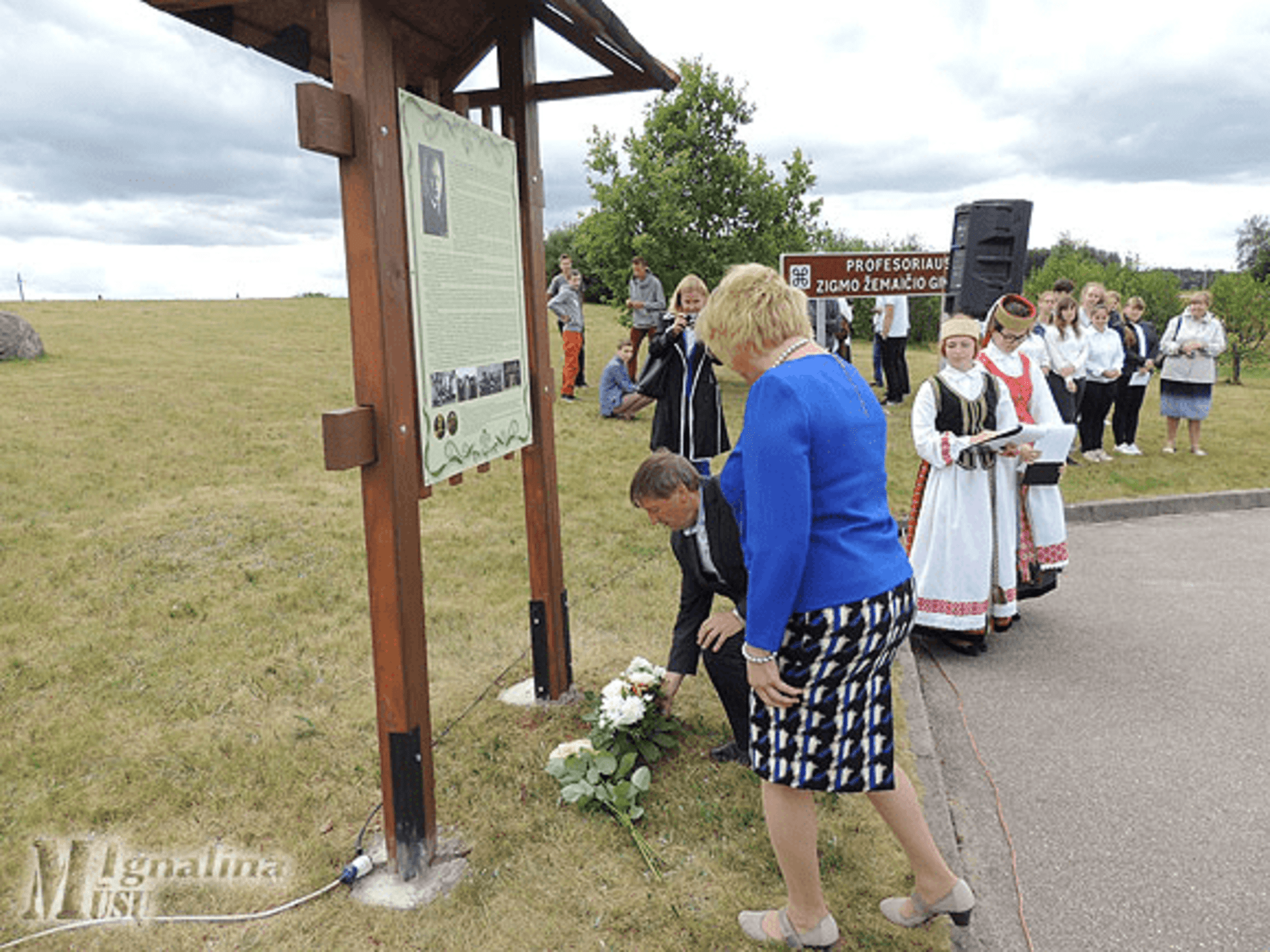
His birthplace, the village of Daktoriai, no longer exists. Near the few remaining homesteads, the Tverečius border guard post was established about twenty years ago. It is gratifying that in June 2018, marking the 100th anniversary of Lithuanian Independence, through the joint efforts of the Tverečius eldership and Didžiasalis „Rytas“ Gymnasium, an informational stand dedicated to Zigmas Žemaitis was unveiled next to the border post. At the cultural evening „Fellow Countrymen Who Built Independent Lithuania“, organized by the gymnasium in 2017, his daughter Irena Žemaitytė-Geniušienė participated and warmly spoke about her father. Thus, this distinguished native of the region has not been forgotten in his homeland.
When the future professor left Tverečius parish for the wider world, the area had about 7,000 inhabitants. Today, the Tverečius and Didžiasalis elderships together number only about 2,000 people. At that time, villages had only recently been freed from serfdom. Life was poor, often hungry — yet there was an immense desire for education and progress. This inspires and moves us, the people of the border region, and reminds us that regardless of the circumstances created by the times, a person’s destiny often depends on their own determination and resolve.
Information updated on 2026-01-13
Reviews