
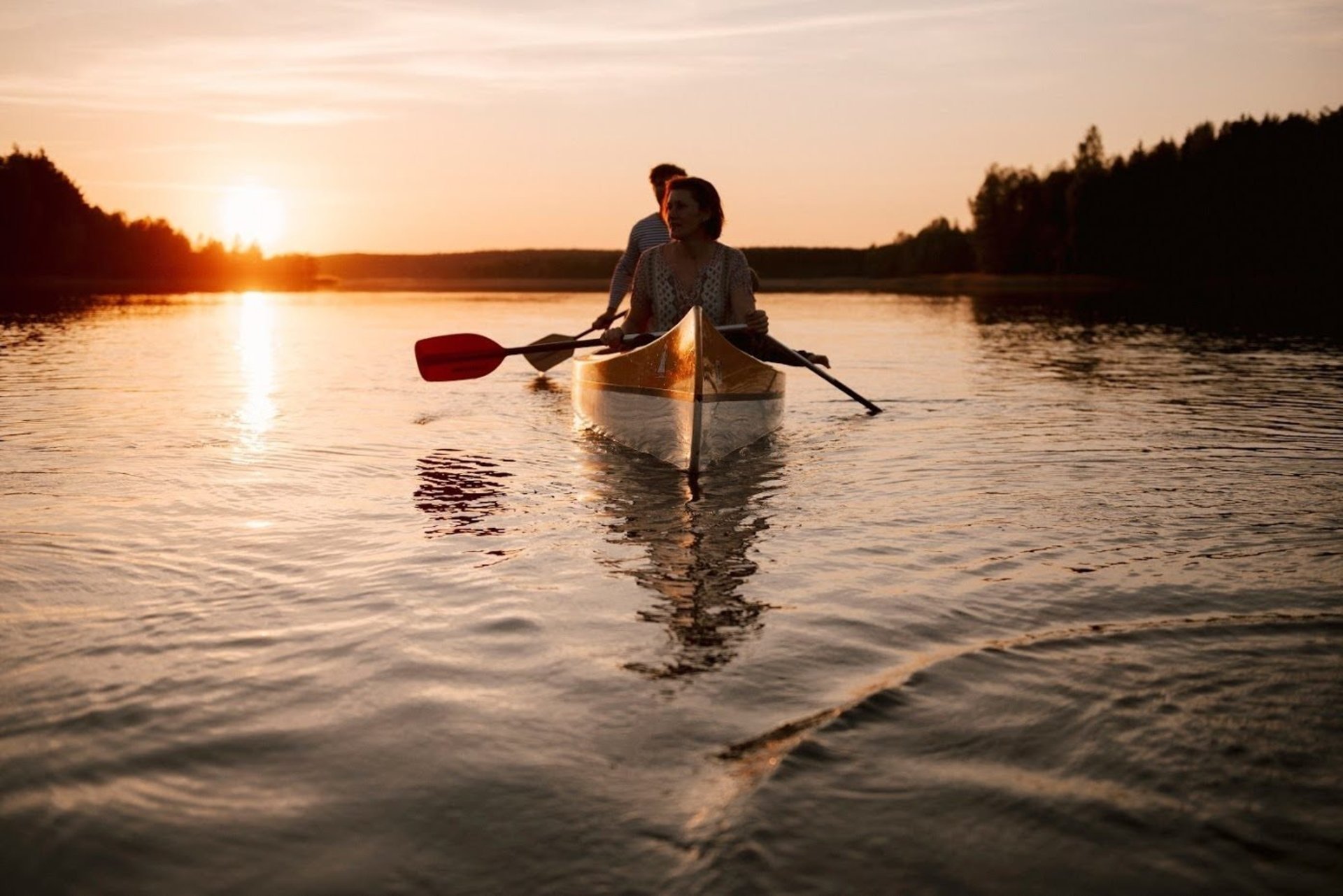
Although there are not many places of interest on the Kiauna River route, we recommend renting a kayak on the Kiauna, as it is one of the most winding rivers in Eastern Aukštaitija. It stretches through Labanoras forests and swamps, which makes kayaking on the Kiauna a lot of fun.
Day 1 swim, 18 km
The most convenient way to start a kayaking trip on the Kiauna River is from the bridge at the end of the Pakiaunis village. From there, launch your kayaks down the Kiauna River. The Kiauna Landscape Reserve begins here. You will swim while observing the beautiful banks of the Kiauna River, forests and marsh vegetation. If you swim in the spring, before the banks are overgrown with reeds, you will be able to see impressively large beaver „houses“ made of mud, branches, water grass and other natural materials. You will swim past the small and cozy villages of Stirninė, Jakutiškis, Vasiuliškė, Žvirbliškė and Kūriniai located near the Kiauna River.
The most „extreme“ and impressive part of kayaking on the Kiauna River starts from the village of Vasiuliškis and continues to the bridge of the village of Kūriniai. In this section of the Kiauna River bed flowing through the forest, you will have to overcome deceptive, rapid river bends and tree thickets. In places, you will have to maneuver between stone boulders. This place is one of the most popular among those water tourism enthusiasts who like to swim in the waters of the Kiauna River while turning over in a kayak.
After passing under the bridge in the village of Kūriniai, which connects the Molėtai – Ignalina road, you will sail for about 2 km along the Kiauna riverbed, which is surrounded by tree-lined riverbanks. At first, the riverbed is very winding, then it is straight, decorated with a beautiful avenue of trees, which, together with the river, seems to flow into a small lake Gilūtas.
Once you enter Gilūtas, turn your kayaks to the left, heading east, and swim about 0.6 km to the channel connecting Gilūtas and Sekluotis lakes. In these lakes, you will probably encounter the owners of these waters – swans. These royal birds always demonstrate their beauty when welcoming guests.
On the right side of the beginning of the channel connecting the lakes, there is a small, cozy lawn, the sandy river bottom shines with gold. A great place for a break and swimming! Enjoy it and stay eco-friendly. Nature lovers, all water tourists, we kindly ask you to leave this place clean and tidy.
After swimming through the 800 m long channel connecting the lakes and covered with reeds, you will reach Lake Sekluotis. Swim along the lake, in an easterly direction. This lake is named so for a reason – while swimming on it, the bottom of the kayak will reach the lush vegetation of the shallow lake. After swimming a good 0.75 km to the end of the lake, turn right, in a southerly direction, and swim all the way to the source of the river.
The part of the Kiauna River that flows from Sekluotis is sometimes called Kernauja. Immediately behind Lake Sekluotis is the village of Kukliai, located on both banks of the river. There is a convenient finish point in the village of Kukliai. You can get off on the lawn on the right side of the river, in front of the concrete bridge.
If you still have enough enthusiasm, travel to the Žeimena River. You will sail along the bed of the Kiauna River, which is lined with pine forests. After traveling 2 km, the slowed-down river flow will take you to the mouth of the Kiauna River. The Kiauna is the first, right tributary of the Žeimena River. It flows into the Žeimena 4.30 km below the source of the Žeimena River, which begins in Lake Žeimenis.
Finish
You will enter Žeimena at the village of Šakališkės, located at the confluence of the Kiauna and Žeimena rivers. Turn left at the confluence. You can finish in the village of Šakališkės, about 400 m from the confluence, or in the town of Kaltanėnai, located 3 km from the confluence. If you finish the hike in Kaltanėnai, you will be able to admire the beautiful, red clay brick Kaltanėnai Church in the neo-Gothic style, built in 1903–1909.
Information updated on 2026-02-24
Reviews